Sunday, 17 January 2021

Surviving the winter lockdown

#StayatHome

So here we are again, only this time it’s worse. We’re in the middle of the second wave of the Covid pandemic and the situation is serious. For the first time since the beginning of this crisis all three traffic lights of the coronavirus-warning system for Berlin are red. The number of Covid-related deaths in Germany is at a record high. The lockdown measures have been toughened once again and even stricter restrictions are expected to be announced next week. 

Unless you keep a steady eye (or ear) on the local news, it’s impossible to keep up with all the changes. The Tagesspiegel App has become my bible. At the moment we can meet only one person from another household (children are now included in the calculation). We are not supposed to leave the house unless we have a valid reason. We are also not supposed to leave Berlin, or at least we can’t go further than 15 km from the border into Brandenburg, our neighbour state. 

The spring lockdown was bad enough, but the winter lockdown is on another level. Winter in Berlin is always a difficult time of the year. I’m not just saying this because I grew up in Sicily. Even native Berliners struggle with the long, grey and dark days, when catching a glimpse of the sun for just a few minutes feels like a miracle. Now that we spend most of our time at home, the days and weeks are a blur. They all seem to be melting into one long week. It feels surreal. Is this really happening or is it all a bad dream? 

Schools have been closed for a month now and the whole school situation has been terribly mismanaged, with conflicting information and backtracking on decisions. Home schooling is proving to be an even greater challenge than during the previous lockdown. Finding the assignments for the week is a bit like a treasure hunt, as the information is uploaded on different websites or arrives by email. Excuses to avoid studying include “I’m hungry”, “I’m tired”, “my arm hurts”, “I need the toilet” and my favourite “my pen exploded”.  Today I read in the news that home schooling and working from home are not compatible. How insightful.   

The online learning platform called Lernraum Berlin (the website that all teachers and students in Berlin are supposed to use) is totally unreliable and keeps crashing. On several occasions, we’ve had to resort to alternative websites for videoconferences. I’m starting to wonder if the people responsible for Lernraum Berlin are the same ones that were managing the construction of the “new” airport.

Talking of Berlin-Brandenburg Willy Brandt Airport (BER) airport, it has been back in the news this week, as employees have reported suffering electric shocks while checking passenger luggage! You couldn’t make this stuff up.

On a positive note, and to parents’ relief, the playgrounds in Berlin are still open, at least for the time being (this wasn’t the case in spring). Usually, playgrounds are deserted at this time of the year, but not now, as they are currently the only place where children can let off steam. 

If you are looking for distractions to survive the winter lockdown, here are some recommendations. 

This week I’ve been watching British sitcom Mum on the Arte App (where you can watch films and tv series in the original language without subtitles). It’s a slow-moving “comedy” with a great cast about a recently widowed, middle-aged woman called Cathy. It has funny moments, but it also makes you cringe. Some of the other characters are quite horrible and you do wonder how Cathy manages to stay so calm and gentle. 

I also watched the documentary Bethany Hamilton: Unstoppable on Netflix . It tells the inspiring story of surfing champion Bethany Hamilton, who lost her arm in a shark attack while surfing as a teenager, and made a comeback against all odds. 

Also on Netflix, the documentary The Social Dilemma will put you off using social media forever, or for a while at least.

I’ve been reading A Manual for Cleaning Women by Lucia Berlin, who has been praised as “a literary genius” in recent years. It’s a wonderful collection of short stories based on events from the author’s diverse and itinerant life. Whether they are based in laundromats, classrooms or the emergency room, Lucia Berlin tells vivid stories with humour and compassion.  

I’ve also been reading The World’s Worst Teachers by David Walliams with my son. Plenty of funny moments in these gruesome stories about the 10 worst teachers in the world, with great illustrations by Tony Ross.

Finally, I’ve been listening to the podcast called The Writer’s Voice, where New Yorker fiction writers read their short stories. A great chance to hear a good story told by its author.

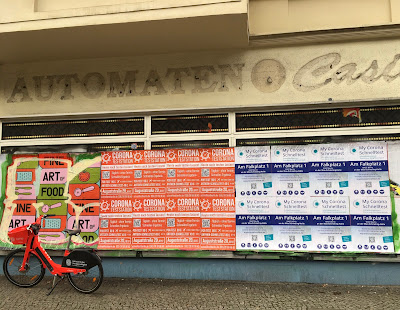
*The poster (pictured) tells Berliners to wear face masks and to follow the Corona-rules. It is a play on the words rumgurken, which can be translated as "hang out" and comes from the word Gurke, i.e. cucumber and Rübe, which means turnip or carrot but is also used to describe an ugly nose.

Tuesday, 15 December 2020

Back to lockdown


The partial lockdown that was supposed to save Christmas has turned into a full Christmas lockdown. 


Today is the last day of lockdown light. As of tomorrow, we will be in a hard national lockdown. From 16 December everything except for essential shops, pharmacies, doctors and dental surgeries will be closed, including schools. Restaurants will remain closed, although they will still be allowed to sell takeaway food. However, outdoor alcohol consumption will not be permitted. So no more drinking Glühwein from outdoor stalls! 

Parents all over Germany are bracing themselves for the hard task of having to entertain children at home during the extended Christmas holiday with little or no contact with friends or family. My survival strategy, at least initially, will involve lots of baking with my son, assuming that flour in supermarkets doesn’t run out, as it did the first-time round. I’ve already seen several people out on the streets carrying huge bags of toilet paper so that is rather concerning. I’m not even going to think about home schooling at this stage.

The national lockdown was only announced on Sunday, giving people little or no time to prepare. Since Monday customers have been queueing outside hairdressers and barbers not knowing when the next chance to get a haircut will be. Luckily I managed to get my hair cut just in time! The lockdown is supposed to last until 10 January, but given the high number of Covid cases and Covid deaths, it may well last longer.

Bookshops are allowed to stay open as they are considered to be “systemically relevant”. So if you haven’t yet done all your Christmas shopping, in Germany you can at least buy books from your local bookshop to avoid using Amazon!

Once upon a time Berlin used to be famous for its cultural and party scene, but nowadays the posters advertising gigs, plays and club nights have been replaced by adverts for Covid test centres. Even the KitKatClub has been turned into a Covid test centre. Where clubbers and fetishists once used to queue up before partying the night away, they now queue up to find out if they are Covid positive. This is the new normal in the year 2020. The only glimmer of hope is that the coronavirus vaccine may soon be approved in the EU as well, so that we might start to see the light at the end of the tunnel.

Friday, 4 December 2020

Solidarity during lockdown


There are plenty of ways to help others


There is no doubt that we are living through difficult times. Lots of countries around the world are currently experiencing a second wave of coronavirus. For people living in the northern hemisphere it’s also the darkest and coldest time of the year and as Christmas approaches, many of us will be spending the holiday season away from our families.  On top of that, we can’t go out to restaurants or to the cinema or theatre or to concerts. Still, there are things we can do to bring some light and joy into our lives and the lives of others.

Support arts and culture 


Do you miss going to the cinema, to the theatre or to other events? Luckily, there are plenty of digital offers. As well as the online streaming giants, there are alternatives, such as, online film festivals, literary festivals and digital theatre, concerts and opera. It’s a great way to combine entertainment with support for the arts and culture sector. This week the National Theatre launched a new streaming service called National Theatre at Home, offering a selection of plays available to watch on demand. You can choose to subscribe or you can pay for a single play. The Royal Opera House is offering digital performances of opera and ballet. Meanwhile in Germany, Human Rights Film Festival Berlin is offering the chance to watch 11 films for 11 days (until 7 December so hurry!). All revenues from ticket sales will benefit three independent cinemas in Berlin. 

Sign a petition


Signing a petition is a fast and effective way to bring about change. I’ve lost count of the number of petitions I sign every day. Here are a few organisations that you might like to support: Avaaz, We Move Europe, change.org, One, just to name a few.

Amnesty International’s global campaign Write for Rights is back this year. You can save lives by signing the petitions to free brave human rights activists. Here are the links to the UK website and to the Italian website. You have time until 10 December! There are lots of other petitions to sign on the Amnesty website.


Donate to a charity


There are so many charities out there that it might feel daunting to choose which one or ones to support. You might prefer to support a well-known charity (UNICEF, Save the Children, Greenpeace, Oxfam, WWF, Médecins Sans Frontières) or a small NGO. I suggest you pick a cause that is close to your heart, whether it’s human rights, women’s rights, animal rights, medical research, climate change, hunger, poverty, helping children, refugees, the homeless, the aged, etc. They are all important causes. You can either donate money or you can donate clothes, books, toys, etc. to charity shops, donation centres or clothing banks.  You can also buy Christmas cards to support charities. In Germany, for instance you can buy UNICEF cards either from post offices or online. 

I recently discovered an app called ShareTheMeal, which is part of the United Nations World Food Programme. You can make a one-time donation or you can choose a monthly subscription. I was matched with a family in Nigeria last month and I could actually see how my gift to “the Table” was spent to buy pasta and local maize.

Human Rights Film Festival Berlin


This week I watched films from the Human Rights Film Festival Berlin. I would like to recommend an uplifting documentary called Learning to Skateboard in a Warzone (If You're a Girl). If you live in Germany, you have until 7 December to watch itThis 40-minute documentary filmed in Afghanistan deservedly won an Oscar this year. It follows the progress of a group of girls who attend Skateistan, a school in Kabul that empowers girls from poor backgrounds by giving them an education and teaching them to skateboard. Its shows a different side of Afghanistan from the one we are used to seeing in the news and it offers a message of hope and courage.  
The film NASRIN, about Iranian human rights lawyer Nasrin Sotoudeh, currently in prison, is available to watch from this evening. You might remember her from Jafar Panahi’s Taxi, which won a Golden Bear at the Berlinale (Berlin Film Festival) in 2015.

Whatever you do, don’t give up hope!


Saturday, 28 November 2020

Life in “lockdown light” – week 4


Lockdown light is not having the desired effect.

As we’re coming to the end of week four of lockdown light, it’s become increasingly evident that while the restrictive measures are working in most parts of Germany, the number of Covid-19 cases in Berlin continues to rise. In some districts, namely, Neukölln and Friedrichshain-Kreuzberg, the number of new infections has increased by as much as 60% in spite of the partial lockdown. Berliners, it would seem, are undisciplined. That doesn’t surprise me at all. As I’ve observed before, the main streets and shopping malls are crowded. Incredibly, some people are not even aware of the rules limiting social contacts. 

Until recently the weather in Berlin had been fairly mild, but now it’s typical November weather. It’s cold and grey and some days it’s difficult to tell the difference between night and day. Nevertheless, people in Berlin don’t like to stay at home. Although Christmas markets are not allowed to open this year, there are alternatives. Kiosks selling Glühwein or mulled wine have popped up in several parts of the city. I’ve even seen a Vietnamese restaurant with a stall on the pavement selling Glühwein

The current partial lockdown measures have been prolonged until 20 December and there has been some toughening of restrictions. For instance, only two households are allowed to meet up, with a maximum of five people (it used to be 10) both indoors and outdoors. But while in the rest of Germany there will be an easing of the lockdown rules to allow gatherings of up to 10 family members and friends during the Christmas holidays, in Berlin there will be no change. Luckily for large families, children under the age of 12 are excluded from these calculations. In Berlin it is not unusual to see families with four children. Having three children is almost the norm these days. 

Talking of Christmas, the Advent season begins on Sunday. In Germany the tradition is to light the first of the four candles of the Adventskranz or advent wreath on the fourth Sunday before Christmas. Although you can buy them in flower shops or even supermarkets, for the past three years we’ve been making our own Adventskranz. It’s not difficult to make, but it helps if you have the right tools: a straw ring (the base), twigs, green wire (for fixing the twigs to the ring), candles, candle holders and anything you might like to use as decoration. Usually, families and friends get together on the four Sundays preceding Christmas and sit at the table with the advent wreath in the middle to drink tea or Glühwein and eat Christmas biscuits, or Plätzchen. This year, Advent season won’t be quite the same.

Finally, I have a new Netflix recommendation. It’s an animated short film called If Anything Happens I Love You. It’s only 12 minutes long, mostly in black and white, with no dialogue, but it’s extremely powerful and moving. 

Friday, 20 November 2020

Life in “lockdown light” – week 3


Be a couch potato, be a hero.


It’s week three of lockdown light and the German government, or Bundesregierung,  has come up with a new strategy to convince young people to stay at home. They are running an online campaign with a series of ironic documentary-style videos showing old people reminiscing about the winter of 2020, a time when they were young and they became heroes by simply doing nothing. In one short film, an old man shows off the medal he was awarded for his outstanding contribution in the fight against coronavirus. He was a lazy slob, who stayed at home all day playing computer games and eating junk food. His friends used to make fun of him, but due to his laziness he became a hero because he stopped the virus spreading. The final message is: “Become a hero too and stay at home”, hashtag #besonderehelden or special heroes.

If the scenes at the Mauerpark last Sunday are anything to go by, it’s likely to be an uphill struggle. Clearly Berlin is not a city of couch potatoes. Crowds gathered at the park, which, by the way, has been enlarged recently. As well as people dancing in close proximity to one another (clearly in defiance of the AHA rules), there were multi-ethnic families having barbeques, aspiring musicians trying out new beats, aspiring acrobats trying out new tricks, graffiti artists spraying on the walls and the usual boules-playing gang.

Meanwhile in a different part of Berlin, Prince Charles was giving a speech, partly in German and partly in English, at the Bundestag, the German Parliament. He was attending a ceremony to commemorate Germany's National Day of Mourning for victims of war. Actually, his German is quite impressive! I wonder if the Prince of Wales is aware that there is a nightclub in Berlin named after him. Unfortunately, the club called Prince Charles, like all other clubs (in case you didn't know, Berlin is famous for its club scene), is closed due to the current Covid restrictions. I should point out that Prince Charles and Camilla are amongst the first passengers to land at the newly opened BER airport. It was worth opening a painfully delayed airport in the middle of a global pandemic after all!

Talking of the royal family, season four of The Crown is finally available to watch on Netflix. My favourite moment so far is when a mystified Margaret Thatcher, played by Gillian Anderson, wonders why she is wasting her precious time at Balmoral, while «struggling to find any redeeming features in these people» (i.e. the royals), who her husband describes as “boorish, snobbish and rude”. Meanwhile, Earls Court, where Lady Diana lives, is a place for “prostitutes and Australians”. That is according to Princess Margaret, played by Helena Bonham Carter. If you think you come from an odd family, don’t worry you’re in good company, even though you might not live in a palace or castle.

Friday, 13 November 2020

Life in “lockdown light” – week 2

Mexico City or Berlin?


The second week of “lockdown light” is coming to an end, but you wouldn’t know it walking around the streets of Berlin. There are plenty of people out and about. At least during the daytime - I haven’t been out in the evenings. There are people inside shops (wearing masks of course) and there are queues outside fast-food and other restaurants serving takeaway. There are also plenty of bikes and cars on the streets and people waiting at tram and bus stops. I have been avoiding public transport, but I hear that S-Bahns and underground trains are pretty full. Of course, bars, cinemas, theatres, museums, fitness studios, etc. remain closed.

When the partial lockdown was announced, it was supposed to be in place for at least four weeks, but it may well last longer. We should find out more on Monday 16 November, when Angela Merkel is due to hold a meeting with regional leaders to discuss the current situation. Meanwhile, the number of Covid infections in Germany continues to rise, but at least the reproduction number (or R value) has fallen below 1 – a positive sign. However, these figures may be misleading as the testing strategy has changed since early November. Patients with colds no longer get tested, because the testing capacity is stretched, so we might be comparing apples with pears.

The Christmas season will feel very different this year. Christmas markets are one of the staples of the festive season in Germany, but many have been cancelled. In Berlin, the traditional Christmas markets at Gendarmenmarkt and Schloss Charlottenburg, as well as the Lucia-Weihnachtsmarkt and the Alt-Rixdorfer Weihnachtsmarkt, won’t be happening this year. The Christmas Garden has also been cancelled. Where will we drink our Glühwein (mulled wine) and eat our waffles with cinnamon sugar, just to mention a couple of the delicacies on sale at the markets?  The simple answer is - at home. I guess I will have to invest in a waffle-maker, or my son will be disappointed.

The most awaited news since the beginning of the pandemic came from Mainz, where the German company BioNTech is based. Together with US pharmaceutical giant Pfizer, they announced that their jointly developed vaccine is 90% effective in preventing people from getting Covid, according to early results from Phase 3 trials. This news was welcomed all over the world: hope is in sight! BioNTech was founded by husband-and-wife team Prof Sahin and Dr Türeci, both children of Turkish immigrants, or Gastarbeiter, as they are called in Germany (literally “guest workers”). Tell that to AfD voters! In case you don’t know, AfD is a far-right anti-immigrant party.  

If you are looking for Netflix recommendations, the series The Queen’s Gambit is one of the best I’ve seen recently. It’s about chess, but don’t be put off by that. It’s very stylish and beautifully shot. Although the action takes place in the US, Mexico City, Paris and Moscow, many of the scenes were actually filmed in Berlin. Filming locations include the Bode Museum, the Friedrichstadt-Palast (pictured), Rathaus Spandau, the Palais am Funkturm, the Berlin zoo, several locations on Karl-Marx Allee in Friedrichshain, including the bar at Kino International, and even the Humana secondhand and vintage shop at Frankfurter Tor. It might feel like Paris or Moscow in the late 1960s, but don’t be fooled, it’s Berlin!


Sunday, 8 November 2020

Life in “lockdown light” – week 1

The first week of “lockdown light”, as it’s being called in Germany, is almost over. Compared with the first lockdown in the spring, when almost everything was closed, this is only a partial lockdown. Meetings are restricted to two households (a maximum of 10 people), both indoors and outdoors, and if you meet someone from a different household you must keep a distance of 1.5 m. Cafes and restaurants can only open for takeaway (thus producing more rubbish than ever, but they need our support to keep going). Bars, cinemas, theatres, operas, concert halls, museums, fitness and yoga studios, swimming pools, nail bars, beauty salons, tattoo studios, etc. have been closed since Monday 2 November. Unlike the previous lockdown, all shops and hairdressers are open, as are libraries and playgrounds, though the number of people allowed inside a shop is limited. 

Crucially schools and nurseries remain open and are not expected to close unless the situation worsens dramatically. As I mentioned before, there is a stage-plan for Berlin schools based on the Corona Ampel, or traffic-light coronavirus-warning system for the city. The Covid situation for each school and district is assessed at the end of the week and parents are informed of the required measures before the start of the following week. At the moment, face masks don’t need to be worn inside classrooms in primary schools, but if the traffic lights were to change that would be the next step. I was surprised to find out that swimming lessons will still take place, as they are part of the school curriculum in year 3, even though pools are closed to everyone else. 

Thus, this lockdown affects primarily the leisure, culture, beauty and catering sectors. Some argue that the closure of shopping malls would have been preferable to shutting down the arts and culture sector, but the government reckons that we tend to socialise more when we go out to the cinema or to the theatre than when we go shopping. The aim of the lockdown is to reduce social contacts by a significant amount to slow the spread of Covid-19. Even though it isn’t as restrictive as the previous one, the word lockdown has very negative connotations. Some of us still have nightmares from the previous lockdown. Others might have coped well the first time round but may be feeling low this time. Of course, the colder weather and shorter days don’t help, at least in the northern hemisphere. 

If you are currently living in full or partial lockdown, here are some more suggestions to help you get through these difficult times

Make sure you take care of both your mental and physical wellbeing. The two often go hand in hand. It’s normal to feel anxious or worried at this time. If you are experiencing severe anxiety, panic attacks, or other symptoms make sure you seek help. Talk to a friend about how you feel and consult a doctor and/or a psychologist. They can help you.

Try to get out as much as possible and exercise regularly. Walking, running or cycling are all great ways to keep active, especially in nature. Head to your local park, forest, lake, beach, hill or mountain. Even though fitness centres and swimming pools are closed, there are alternatives. For example, I’ve gone back to yoga and pilates lessons via Zoom. Although it’s not the same as exercising in a room with other people, there are significant benefits to digital exercise. 

Try to find distractions to help you switch off from all the negative and worrying news. This week the cliffhanger “US presidential election 2020” has provided a welcome source of distraction and entertainment. I can’t wait for Netflix to make the second season! What’s that? Are you seriously suggesting this is not a tv-series, it’s for real? 

Here are some other suggestions: read a book, watch a film, listen to music, bake a cake, look after your plants or buy a plant, call a friend, whatever helps you relax. 

Meanwhile, the list of recommendations to avoid the spread of Covid-19 gets longer and longer, as I discovered while cycling past this advertising board the other day. 


It used to be AHA, an abbreviation that stood for distance, hygiene and masks. Now it’s: 

Keep a distance

Wash your hands

Wear a mask

Ventilate regularly 

Reduce contacts

Use the app

Just to give you an idea of what they mean by “ventilate regularly”, classrooms need to be aired every half hour. That means opening all the windows, as well as the door, for five minutes every 30 minutes.  As the weather gets colder, schools and parents are considering investing in air filters for each classroom to avoid freezing when the winter really hits. Of course, the most effective air filters tend to be a lot more expensive. I’m waiting to see if they find a solution.